The duration of charging an electric vehicle (EV) depends on multiple factors, including battery capacity, charging power, state of charge, and environmental conditions. Understanding these factors helps EV users plan charging routines efficiently and operators optimize infrastructure deployment.
1. Battery Capacity
Battery capacity, measured in kilowatt-hours (kWh), is the most fundamental factor affecting charging time. Larger batteries require more energy and thus longer charging periods. For example:
-
A small EV with a 40 kWh battery may require 6–8 hours to fully charge on a 7 kW AC charger.
-
A large EV with a 100 kWh battery may need 12–14 hours under the same conditions.
For DC fast charging, larger batteries can still reach 80% charge within 30–60 minutes, depending on the power output.
2. Charging Power
Charging power determines the rate at which energy flows into the battery. It is influenced by both the charging station and the vehicle’s maximum intake capacity.
-
AC charging: Typically 3–22 kW. Power is limited by the vehicle’s on-board charger. Slower but suitable for overnight or long-duration charging.
-
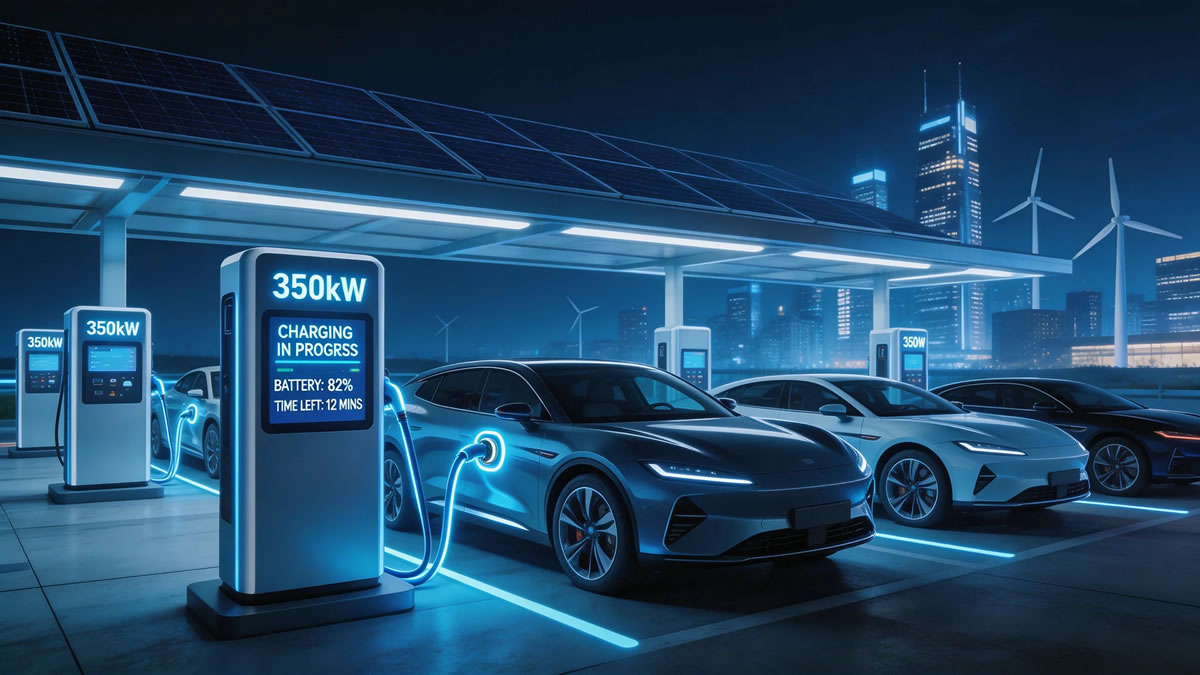
DC charging: Typically 50–350 kW. Directly supplies DC power to the battery, allowing for rapid charging. Ultra-fast DC chargers can deliver high energy in short periods.
Key point: Even if a DC charger is rated at 150 kW, the vehicle may only accept 100 kW due to battery limitations.
3. State of Charge (SOC) and Battery Management
EV batteries do not charge at a constant speed:
-
Charging is fastest when the battery is low (0–20% SOC).
-
As the battery approaches full capacity (80–100% SOC), charging power gradually decreases to protect battery life.
This tapering is especially noticeable in fast DC charging, where the first 80% may take 20–30 minutes, but the last 20% can take as long.
Battery management systems (BMS) regulate voltage, current, and temperature to prevent overcharging and overheating.
4. Environmental Factors
Ambient temperature affects charging efficiency:
-
Cold weather: Battery chemistry slows down, reducing charging speed and efficiency. Pre-conditioning the battery can help.
-
Hot weather: Charging systems reduce power to prevent overheating. Cooling systems are critical for high-power DC chargers.
Other factors include grid stability, simultaneous demand on public chargers, and cable limitations.
5. Charger Type and Infrastructure
Different charger types offer different charging durations:
| Charger Type | Power | Approx. Full Charge Time (mid-size EV) |
|---|---|---|
| AC Home Charger | 3–7 kW | 6–12 hours |
| AC Commercial | 11–22 kW | 3–6 hours |
| DC Fast Charger | 50–100 kW | 30–60 minutes (0–80%) |
| DC Ultra-fast | 150–350 kW | 15–30 minutes (0–80%) |
Note: Charging beyond 80% using DC fast chargers is slower due to battery protection.
6. Practical Recommendations
-
Daily use: AC charging at home or office is sufficient. Charge overnight to fully replenish battery.
-
Long trips: Use DC fast chargers strategically to minimize downtime. Start charging before battery drops too low.
-
Battery health: Avoid frequent top-ups to 100% on DC fast chargers; use AC charging for routine replenishment.
Summary
EV charging time is influenced by battery capacity, charger power, SOC, environmental conditions, and vehicle compatibility. A well-planned combination of AC and DC charging ensures efficiency, convenience, and battery longevity. Understanding these variables empowers users to plan trips, optimize energy use, and reduce “range anxiety.”
 March 20, 2026