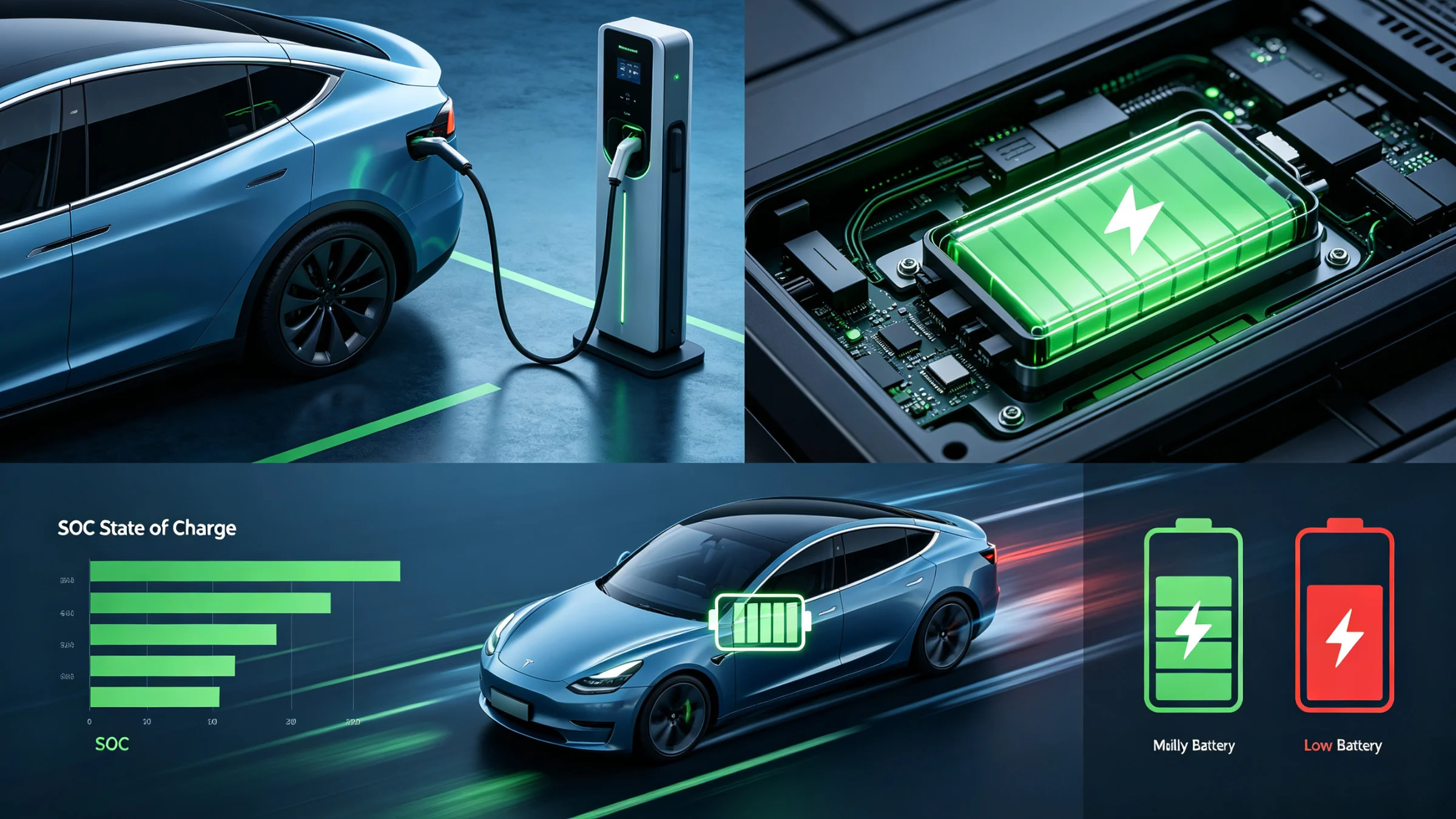
When charging an electric vehicle, the battery percentage displayed on the dashboard is more than just a simple number. It represents the battery's State of Charge (SOC) and can affect charging speed, charging time, and how the vehicle manages energy.
Many EV drivers notice that charging seems faster when the battery level is low and becomes slower as it approaches a high percentage. This is a normal part of modern battery management.
Understanding SOC can help EV owners better understand how their vehicle charges and why charging behavior changes during a session.
1. What Does SOC Mean?
SOC stands for State of Charge.
It indicates the approximate amount of energy currently available in the battery compared with its usable capacity.
For example:
- 20% SOC → battery has relatively little energy remaining
- 50% SOC → approximately half of the usable capacity remains
- 80% SOC → battery is highly charged
- 100% SOC → battery has reached its configured full-charge level
SOC is normally displayed as a percentage on the vehicle's dashboard or mobile application.
2. Why Does Charging Speed Change?
Charging power does not always remain constant throughout a charging session.
When the battery has a lower SOC, the vehicle may be able to accept relatively high charging power.
As the battery level increases, the vehicle's battery management system may gradually reduce charging power.
This helps manage:
- Battery voltage
- Temperature
- Charging safety
- Battery performance
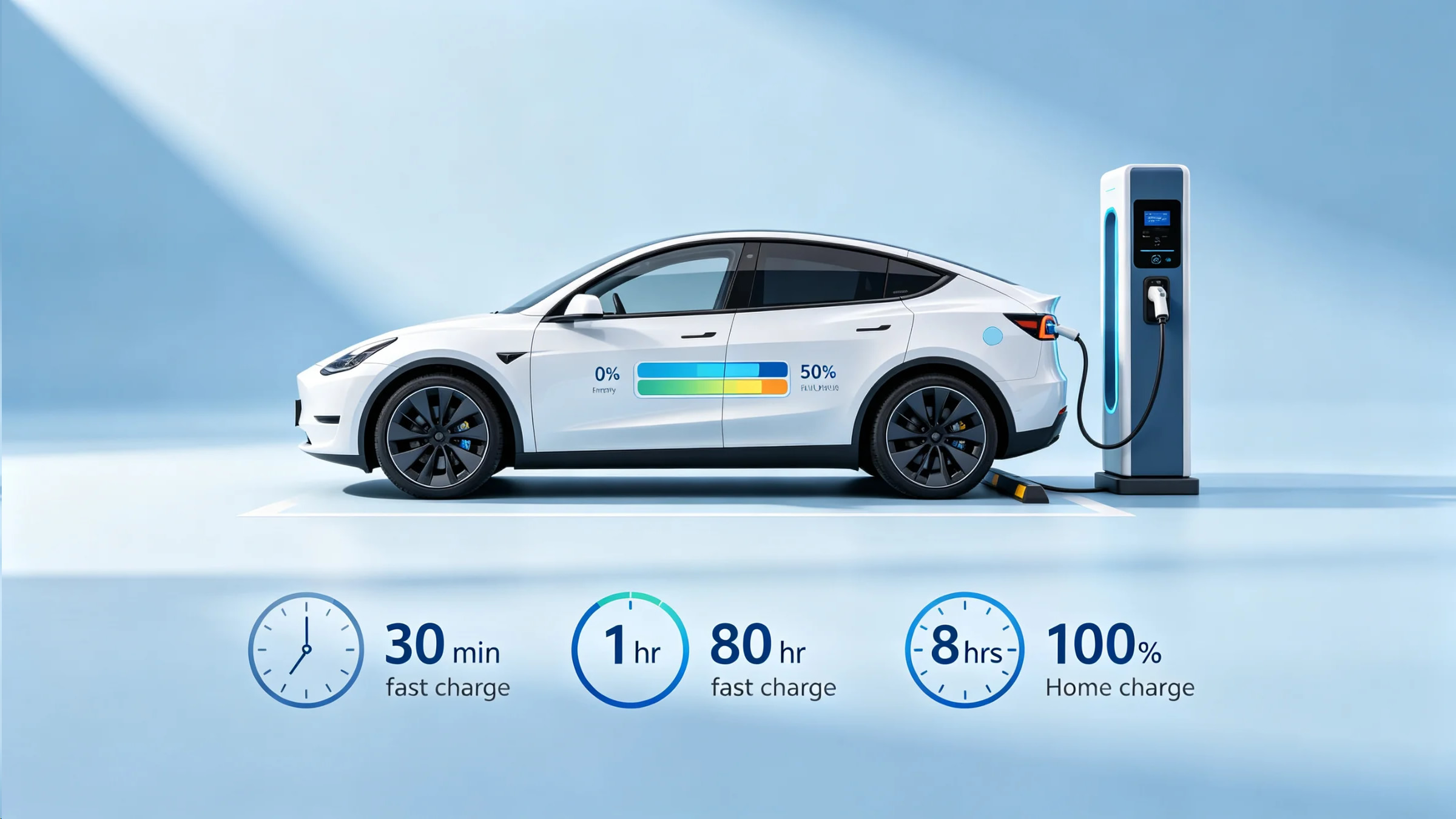
As a result, charging from 20% to 80% can take significantly less time than charging from 80% to 100%, even though both ranges represent 60 percentage points.
3. Why Does Charging Slow Down Near 100%?
EV batteries require careful control as they approach a high state of charge.
The charging system may gradually reduce current to maintain appropriate battery conditions.
A simplified charging pattern may look like:
Low SOC → Higher charging power
Medium SOC → Stable charging
High SOC → Reduced charging power
Near 100% → Significantly slower charging
This behavior is particularly noticeable during DC fast charging.
4. Does a Higher-Power Charger Always Charge Faster?
Not necessarily.
The actual charging speed is limited by the complete charging system.
Important factors include:
- Charger power
- Vehicle charging capability
- Battery temperature
- Battery SOC
- Electrical conditions
For example, a 22kW AC charger cannot force a vehicle that supports only 11kW AC charging to accept 22kW.
Similarly, a high-power DC charger may not operate at its maximum rated output throughout the entire charging session.
5. How Does Temperature Affect Charging?
Battery temperature can also influence charging performance.
Very low or very high battery temperatures may cause the vehicle to reduce charging power.
Modern EVs can use battery management and thermal management systems to help maintain an appropriate operating temperature.
Some vehicles can also precondition the battery before high-power charging.
Therefore, charging performance can vary depending on:
- Outside temperature
- Battery temperature
- Driving conditions
- Charging method
6. Do You Always Need to Charge to 100%?
Not necessarily.
The appropriate charging level depends on the vehicle manufacturer's recommendations and the driver's needs.
For daily driving, many EV owners may only need enough energy for their expected trips rather than charging to 100% every time.
For long-distance travel, a higher SOC can provide additional driving range.
The important point is:
Charging to 100% is a choice based on driving needs, not a requirement for every charging session.
Always follow the recommendations provided by the vehicle manufacturer, especially for long-term battery care.
7. Why Is 80% Often Mentioned?
The 80% level is frequently discussed because charging speed can begin to decrease significantly as the battery approaches a high SOC.
For DC fast charging, stopping around a high-but-not-full SOC can sometimes provide a better balance between:
- Charging time
- Driving range
- Energy added
For example, during a long trip, charging from 20% to 80% and continuing the journey may be more time-efficient than waiting for the battery to reach 100%.
The ideal charging strategy depends on the vehicle and journey.
8. Simple Example
Imagine an EV with a usable battery capacity of 60kWh.
If the battery is at 20% SOC and you want to reach 80%, you need approximately:
60 × 60% = 36kWh
If the effective charging power averages 9kW:
36 ÷ 9 ≈ 4 hours
This is only a simplified calculation. Actual charging time can vary because charging power changes during the session.
9. What EV Owners Should Remember
There are four basic points to keep in mind:
SOC affects charging behavior.
Higher charging power does not guarantee constant charging speed.
Temperature can influence charging performance.
The best charging level depends on your actual driving needs.
Understanding these principles makes EV charging behavior much easier to predict.
Quick Summary
| Factor | Effect on Charging |
|---|---|
| Low SOC | Charging power may be higher |
| High SOC | Charging power may decrease |
| Low/High Battery Temperature | Charging may slow down |
| Higher Charger Power | Faster only if vehicle supports it |
| Near 100% SOC | Charging generally becomes slower |
State of Charge, or SOC, is an important concept for understanding EV charging. The battery percentage not only tells drivers how much energy remains, but can also influence charging power and charging time.
As the battery approaches a high state of charge, charging power may decrease to help manage battery conditions. Temperature, vehicle specifications, and charger capability can also affect the actual charging experience.
For EV owners, understanding SOC provides a clearer picture of why charging speeds change and helps them plan charging around their daily driving and travel needs.
EV charging is not simply about adding energy as quickly as possible—it is about managing energy efficiently, safely, and according to the vehicle's needs.
 September 3, 2026